1

Air Service Boys Over the Rhine; Or, Fighting Above the Clouds — Themes and Context
(0 User reviews)
243
Project Gutenberg
2010
Not confirmed
World War, 1914-1918 -- Aerial operations -- Juvenile fiction; Parmly, Jack (Fictitious character) -- Juvenile fiction; Raymond, Tom (Fictitious character) -- Juvenile fiction; Air pilots, Military -- Juvenile fiction
Readers of public-domain and historical texts
Project Gutenberg digital edition
en
Edition facts
Words
48,236
Reading time
210 min
Text sections
5
For Air Service Boys Over the Rhine; Or, Fighting Above the Clouds — Themes and Context, the stored edition analysis reports 48,236 words, 3 hr 30 min estimated reading time, and 5 detected text sections.
The text analysis averages about 15.4 words per sentence, while the detected sections provide another way to judge how the source is divided.
Project Gutenberg metadata also associates the work with “World War, 1914-1918 -- Aerial operations -- Juvenile fiction,” connecting these edition facts with the source record’s subject description.
Source:
Project Gutenberg record #33834
In this 1919 aviation adventure, Tom Raymond and Jack Parmly of the Lafayette Escadrille count returning planes, face the long-range German gun shelling Paris, and prepare for a perilous mission over the Rhine. The narrative contrasts anxious waiting with airborne action, and uses precise technical details like Caudrons, Nieuports, and tracer bullets.
Editorial Edition Score
4.7/5
★★★★★
★★★★★
Calculated from edition completeness, EPUB availability, text structure and catalogue metadata. Not a user rating.
How this score is calculated
- Description quality20 pts
- Title & short description10 pts
- Source metadata20 pts
- Text length15 pts
- Chapters / structure15 pts
- EPUB file integrity20 pts
Total of 100 points, scaled to a 2.5-5.0 range. Editions with an empty description or a missing EPUB file are not scored.
Edition quality
Public-domain source text
Read the source text
The source text is kept in the dedicated reader, separate from this catalogue record and its commentary.
The story opens with a tense count: two young pilots, Tom Raymond and Jack Parmly, scan the sky for returning Caudrons after a night raid. Only eight of ten planes come back, and the missing airmen are presumed killed or captured. This arithmetic of loss—counting specks that become birds, then machines, then friends—sets a pattern of anxious arithmetic that recurs throughout the excerpts.
The narrative voice is brisk, favoring short, declarative sentences and colloquial exchanges (“You said something!”). Technical terms such as “petrol tank,” “Lewis machine gun,” and “tracer bullets” are woven into dialogue without explanation, assuming a reader already familiar with Great War aviation. The setting shifts between the hangar field “somewhere in France” and Paris under bombardment from a mysterious long-range gun.
Counting and Waiting
The opening chapter establishes a rhythm of watching and tallying. Tom and Jack count planes, then count survivors: “I can count only eight.” The narrator reports that ten went out, so “at least four of our airmen have either been killed or captured.” This blunt arithmetic recurs when a pilot reports his brother’s plane caught fire: “It’s all up with him and La Garde.” The emotional weight is carried by understatement—the pilot turns aside for a moment, then vows revenge.
Later, in Paris, the same pattern applies to shells from the big gun: “a sudden explosion a few blocks away announced the arrival of another German shell.” The characters watch, wait, and count again. The text does not linger on grief; it moves quickly to the next mission. This compression of emotion into action is a structural feature of the series, which prioritizes forward momentum over interior reflection.
Technical Talk and Tactical Detail
The dialogue is laced with specific equipment and procedures. Jack checks “struts and wires” before a flight; Tom adds “tracer bullets” to his ammunition, noting that they “enable the pilot to see the course his machine gun bullets are taking.” The squadron uses “single-seat, swift-flying craft, equipped with a Lewis machine gun.” These details are not explained for the novice; they are the working vocabulary of the characters.
The mission described in Chapter XV is a patrol: “each pilot was to observe what he could behind the German lines, and come back to report.” The small machines carry no wireless, so the pilot himself must return with the intelligence. This constraint heightens the stakes of survival. The text also distinguishes aircraft types: Caudrons for bombing, Nieuports for pursuit. The cumulative effect is a texture of authenticity, even if the technical accuracy is period-typical rather than modern.
The Big Gun and the Paris Front
Part of the action takes place in Paris, where Tom and Jack meet Bessie Gleason and her mother. The city is under shelling from a German long-range cannon—a weapon that appears in the chapter titles as “A Monster Cannon” and “The Big Gun.” The shelling is described in quick, almost journalistic bursts: “Fortunately, however, the shots did little beyond material damage, no one being killed.” German planes appear overhead to observe the effect, and French airmen rise to meet them.
The searchlights “pick out the hostile craft,” and the narrative notes that “more than one Boche never got back over his lines again.” The civilian setting provides a contrast to the airfield: a quiet restaurant is interrupted by an explosion, and the characters watch the aerial combat from the ground. This dual perspective—on the ground and in the air—is a recurring structural device, allowing the reader to experience both the waiting and the fighting.
Readers should note that the excerpts cover only the first third of the book (chapters 1–15) and a fragment of later action. The full novel includes chapters on imprisonment and escape (“Prisoners,” “The Escape”) that are not represented here. The tone remains consistently brisk, with dialogue driving the plot and technical details grounding the fantasy of flight. The series formula—two friends, a missing father, and a war—is clearly established, but the specific texture of this volume lies in its focus on the long-range gun and the count of returning planes.
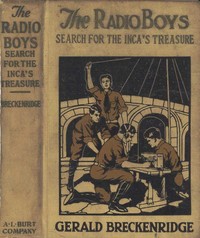
I remember how the Air Service Boys counted their returning planes, each one a small hope against the shelling over Paris. That same patient wristwatch feeling lives quietly inside The Radio Boys' Search for the Inca's Treasure — Inside the Classic, where waiting for a distant signal holds its own tender gravity, a kinship between boys and the sky they trust.
There are no reviews for this eBook.
There are no comments for this eBook.
Reader reflection
Record your reading impressions
A brief reflection can help important ideas stay with you longer.
Your progress
0
/
10
2
Was reading this book enjoyable?
3
Would you recommend this book to another reader?
4
How easy was the book to follow?
5
How distinctive were its ideas or approach?
6
How did the reading compare with what you expected?
7
Did the book give you something worth debating?
8
What was the strongest part of the book?
9
In one sentence, what did you learn?
10