1

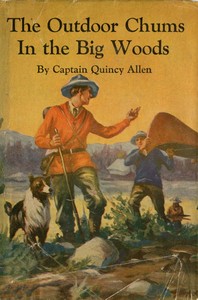
The Outdoor Chums in the Big Woods; Or, Rival Hunters of Lumber Run — Story, Setting & Ideas
(0 User reviews)
49
Project Gutenberg
2013
Not confirmed
Adventure stories; Hunting stories; Maine -- Juvenile fiction; Lumber camps -- Juvenile fiction
Readers of public-domain and historical texts
Project Gutenberg digital edition
en
Edition facts
Words
53,622
Reading time
234 min
Text sections
5
Before opening The Outdoor Chums in the Big Woods; Or, Rival Hunters of Lumber Run — Story, Setting & Ideas, the edition data offers a quick orientation: 53,622 words, 3 hr 54 min estimated reading time, and 5 detected text sections.
The text analysis averages about 17.4 words per sentence, while the detected sections provide another way to judge how the source is divided.
Project Gutenberg metadata also associates the work with “Adventure stories,” connecting these edition facts with the source record’s subject description.
Source:
Project Gutenberg record #42630
An editorial note examining the brisk, dialogue-driven opening and the practical, problem-solving narrative voice in Quincy Allen's 1915 adventure, focusing on how the author balances action with detailed descriptions of camp craft and hunting.
Editorial Edition Score
4.7/5
★★★★★
★★★★★
Calculated from edition completeness, EPUB availability, text structure and catalogue metadata. Not a user rating.
How this score is calculated
- Description quality20 pts
- Title & short description10 pts
- Source metadata20 pts
- Text length15 pts
- Chapters / structure15 pts
- EPUB file integrity20 pts
Total of 100 points, scaled to a 2.5-5.0 range. Editions with an empty description or a missing EPUB file are not scored.
Edition quality
Public-domain source text
Read the source text
The source text is kept in the dedicated reader, separate from this catalogue record and its commentary.
The Outdoor Chums in the Big Woods opens not with a description of the Maine wilderness but with a snowball fight. The first line of dialogue—'That looks like a challenge, Frank'—immediately establishes the group's dynamic: Frank Langdon as the leader, Bluff as the instigator, and the others as eager participants. The narrative voice shifts quickly from the boys' banter to a direct address to the reader, explaining the Rod, Gun, and Camera Club's origins. This blend of action and exposition sets the tone for a story that values both adventure and practical know-how.
Dialogue as a Driver of Pace
The opening chapter relies heavily on rapid-fire exchanges to propel the scene. Lines like 'It was well fired, at any rate, Bluff!' and 'Do we stand for that sort of thing, or shall we accept the dare?' create a sense of immediacy. The author uses dialogue not just for characterization but to advance the plot: the snowball fight leads directly to a broken window, which then prompts the boys' trip to the Big Woods. This technique keeps the narrative moving briskly, with minimal descriptive pauses. Later, in the woods, dialogue continues to drive action—when Frank says 'Let's see if we can find an old ax around,' the conversation immediately shifts to building a litter. The speech patterns are colloquial and period-appropriate, with exclamations like 'Shucks' and 'Talk to me about Oriental palanquins' adding flavor without slowing the pace.
Practical Problem-Solving in the Narrative Voice
The narrator frequently steps back from the action to explain how the boys accomplish tasks, giving the story a how-to quality. For instance, when Frank and Jerry build a litter, the text details: 'All they had to fasten the poles together with consisted of their stout bandannas and some cord Jerry chanced to find in his coat pocket.' This attention to method—selecting saplings, trimming branches, spreading hemlock boughs—reflects the educational aim of the Outdoor Chums series. The voice is matter-of-fact, treating each challenge as a puzzle to be solved. Even the hunting scenes are described with an eye toward technique: 'they succeeded in dropping two birds, and that comforted Jerry a little.' The narrative never sensationalizes danger; instead, it emphasizes resourcefulness and teamwork.
Shifts in Setting and Tension
The story moves from the familiar town of Centerville to the remote Maine woods, and the narrative pace adjusts accordingly. Early chapters are filled with energetic snowball fights and preparation, but once the boys reach Lumber Run, the tempo slows to accommodate detailed descriptions of the camp and forest. The excerpt from Chapter XIV shows a different kind of tension: the discovery of a wounded boy in a locked cabin. Here, the narrative becomes more deliberate, focusing on Frank's decision-making: 'Frank knew there was only one thing that could be done: the wounded boy must be taken to their camp.' The shift from playful adventure to serious responsibility is handled through the same practical voice, with no melodrama. The author balances moments of danger—like the bear trap—with quieter interludes of hunting and camp life, creating a varied rhythm that keeps the reader engaged.
Readers will find that the book's appeal lies less in plot twists than in the detailed depiction of how the chums navigate the woods. Pay attention to the way Allen uses dialogue to reveal character and the narrator's calm, instructional tone. The story rewards those who enjoy seeing problems solved through ingenuity rather than luck.
There's something comforting about how Quincy Allen lets his boys solve problems with their hands—patching a canoe, reading a track—before any rush to adventure. It reminds me of the quiet patience in Letty and the Twins — Key Ideas to Explore, where small domestic moments carry their own kind of steady weight. Both feel like old friends who never raise their voices.
There are no reviews for this eBook.
There are no comments for this eBook.
Reader reflection
What did you think of this book?
Answer a few questions and save a private reflection on this device.
Your progress
0
/
10
2
Was reading this book enjoyable?
3
Is this a title you would suggest to others?
4
What was the reading difficulty like?
5
How clearly were the main ideas presented?
6
Which element worked best for you?
7
Is this a title worth rereading?
8
How much did the book move you?
9
What is the main idea you are taking away?
10