1

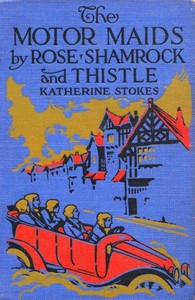
The Motor Maids by Rose, Shamrock and Thistle — Reading Notes
(0 User reviews)
1495
Project Gutenberg
2011
Not confirmed
Voyages and travels -- Juvenile fiction; Automobile travel -- Juvenile fiction; England -- Description and travel -- Juvenile fiction; Ireland -- Description and travel -- Juvenile fiction; Scotland -- Description and travel -- Juvenile fiction
Readers of public-domain and historical texts
Project Gutenberg digital edition
en
Edition facts
Words
59,250
Reading time
258 min
Text sections
27
Before opening The Motor Maids by Rose, Shamrock and Thistle — Reading Notes, the edition data offers a quick orientation: 59,250 words, 4 hr 18 min estimated reading time, and 27 detected text sections.
The text analysis averages about 15.0 words per sentence, while the detected sections provide another way to judge how the source is divided.
Project Gutenberg metadata also associates the work with “Voyages and travels -- Juvenile fiction,” connecting these edition facts with the source record’s subject description.
Source:
Project Gutenberg record #35857
An editorial note examining Katherine Stokes's diction, dialogue, and descriptive choices in this Motor Maids adventure across England, Ireland, and Scotland, focusing on how language reveals character and setting.
Editorial Edition Score
4.8/5
★★★★★
★★★★★
Calculated from edition completeness, EPUB availability, text structure and catalogue metadata. Not a user rating.
How this score is calculated
- Description quality20 pts
- Title & short description10 pts
- Source metadata20 pts
- Text length15 pts
- Chapters / structure15 pts
- EPUB file integrity20 pts
Total of 100 points, scaled to a 2.5-5.0 range. Editions with an empty description or a missing EPUB file are not scored.
Edition quality
Public-domain source text
Read the source text
The source text is kept in the dedicated reader, separate from this catalogue record and its commentary.
From the opening lines aboard ship, Katherine Stokes establishes character through dialogue that blends regional inflection with personality. The stewardess's call—"Lydies wouldn't bithe in it"—immediately signals a specific voice, while Billie's brisk reply and Nancy's groans create contrasting temperaments without exposition. Stokes often lets speech carry the burden of characterization: Nancy's "Irish inconsequence" is shown, not told, through her remark about not wanting to last. The author's ear for vernacular extends to the Duke of Kilkenty's clipped commands and Feargus's defiant retort, where class tension is compressed into direct address.
Dialogue as Characterization
Stokes uses dialogue to differentiate her cast with economy. Billie's practical, cheerful tone—"Lots of food and fresh air will always cure seasickness"—reveals her healthy ignorance, while Nancy's hyperbolic "Eggs!" and shudder convey seasickness through sound alone. Later, Feargus's refusal to be ordered off the Duke's grounds—"I'll leave it when I get ready and no sooner"—establishes his pride and independence in a single sentence. The Duke's reply is not given; his exit is described with a terse "Turning on his heel, he strode across the fields," letting action complete the exchange. Stokes trusts her readers to infer power dynamics from what is said and what is left unsaid.
Descriptive Economy in Setting
Stokes often sketches settings with a few precise details rather than lengthy description. The ship's rolling is conveyed through Billie's unsteady steps and the stewardess's voice outside the door. The bull incident is rendered through physical sensation—"The fields seemed to be swimming around her"—rather than a panoramic view. When Billie recalls little after the confrontation, Stokes writes "Billie remembered very little more after that," using the character's limited perception to control pacing. This technique keeps the narrative focused on the girls' immediate experience, aligning the reader with their perspective.
Voice and Regional Identity
Stokes marks characters by their speech patterns, particularly through dialect and idiom. The stewardess's dropped h's and altered vowels ("lydy" for "lady") create a class and regional marker. Nancy's "Irish inconsequence" is a narrative label, but her dialogue—"I'm sure I don't want to last, even if I do"—embodies the trait. Feargus's defiance includes a jab at the Duke as "any other Irishman turned English," tying his identity to national pride. These choices are not merely decorative; they ground the story in a specific social landscape where accent signals allegiance and conflict.
Narrative Gaps and Inferred Tension
Stokes occasionally withholds information, creating mystery through what is not said. After the bull incident, Billie hears Feargus mutter "Devil incarnate" but the full context is deferred. Feargus's later agitated acceptance of the courier position is accompanied by a failed smile and a request for secrecy—"Would you mind not mentioning to any one that I am going?"—leaving the reader to wonder about his unseen encounter. These gaps are not flaws but deliberate authorial choices that build suspense and invite inference, especially given the excerpts' incompleteness regarding the full plot.
Readers attentive to Stokes's craft will find a story told as much through what characters say and how they say it as through action. The author's restraint in description and her reliance on dialogue to convey emotion, class, and conflict reward close reading. Pay particular attention to shifts in register—between the girls' colloquial banter, the stewardess's dialect, and the Duke's formal contempt—as these vocal contrasts drive the narrative's social commentary.
Reading Katherine Stokes’s descriptions made me think of a rainy afternoon, lost in that old book of my aunt’s. Something about how a landscape can hold a quiet courage. Grit A-Plenty: A Tale of the Labrador Wild — Reading Notes gave me that same feeling later—a gentleness beneath the grit, a memory I didn’t know I’d kept.
There are no reviews for this eBook.
There are no comments for this eBook.
Reader reflection
Record your reading impressions
A brief reflection can help important ideas stay with you longer.
Your progress
0
/
10
2
What was your overall reaction to the book?
3
How likely are you to recommend this book?
4
What was the reading difficulty like?
5
Would you like to discuss this book with someone?
6
Do you expect to return to this book?
7
Which part made the strongest impression?
8
Was the book easy to understand?
9
Which lesson or insight stayed with you?
10