1

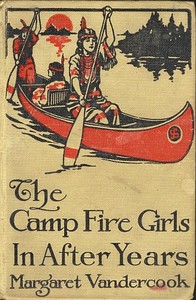
The Camp Fire Girls in After Years — Background and Themes
(0 User reviews)
757
Project Gutenberg
2011
Not confirmed
Camp Fire Girls -- Juvenile fiction; Adventure and adventurers -- Juvenile fiction; Mystery and detective stories; Courtship -- Juvenile fiction; Interpersonal attraction -- Juvenile fiction; Young women -- Societies and clubs -- Juvenile fiction; Colorado Springs (Colo.) -- Juvenile fiction
Readers of public-domain and historical texts
Project Gutenberg digital edition
en
Edition facts
Words
46,510
Reading time
203 min
Text sections
6
The catalog record for The Camp Fire Girls in After Years — Background and Themes provides practical reading context through 46,510 words, 3 hr 23 min estimated reading time, and 6 detected text sections.
The text analysis averages about 18.9 words per sentence, while the detected sections provide another way to judge how the source is divided.
Project Gutenberg metadata also associates the work with “Camp Fire Girls -- Juvenile fiction,” connecting these edition facts with the source record’s subject description.
Source:
Project Gutenberg record #34926
This editorial note examines how Margaret Vandercook's 1915 novel balances Camp Fire Girls club ideals with individual characters' adult dilemmas, focusing on Polly O'Neill's reunion with Richard Hunt and her rescue of a mute girl named Bobbin. The catalog subjects emphasize adventure and mystery, but the excerpts reveal a quieter story of memory, class, and emotional restraint.
Editorial Edition Score
4.7/5
★★★★★
★★★★★
Calculated from edition completeness, EPUB availability, text structure and catalogue metadata. Not a user rating.
How this score is calculated
- Description quality20 pts
- Title & short description10 pts
- Source metadata20 pts
- Text length15 pts
- Chapters / structure15 pts
- EPUB file integrity20 pts
Total of 100 points, scaled to a 2.5-5.0 range. Editions with an empty description or a missing EPUB file are not scored.
Edition quality
Public-domain source text
Read the source text
The source text is kept in the dedicated reader, separate from this catalogue record and its commentary.
Margaret Vandercook’s The Camp Fire Girls in After Years (1915) opens not with a campfire or a club meeting, but with an elaborate inaugural ball shrouded in anxiety. The third-floor room is “in almost total darkness save for a single tiny flame,” and the heroine, Polly O’Neill, appears on the steps “grave and frightened.” The catalog subjects list “Camp Fire Girls -- Juvenile fiction” and “Mystery and detective stories,” yet the excerpts show little detection and no group activities. Instead, the narrative dwells on Polly’s private memories, her strained reunion with Richard Hunt, and her impulsive adoption of a half-savage child named Bobbin. The club framework is present only as a backdrop; the actual story concerns adult loneliness and the weight of past choices.
A Club in Name Only
The catalog labels this a Camp Fire Girls story, but the excerpts contain no scenes of club meetings, ceremonies, or group outings. Polly O’Neill lives alone in a large house with a maid, Marie. Her thoughts turn to Betty Graham and Sylvia—presumably fellow Camp Fire Girls—only when she considers writing them for advice about Bobbin’s clothes. The club’s ethos of service and sisterhood is implied rather than enacted. Vandercook uses the Camp Fire name as a shorthand for a certain kind of wholesome girlhood, but the narrative has moved beyond that world. Polly’s past as an actress and her current isolation suggest that the club’s influence is now a memory, not a present force.
Silence and Subtext
Bobbin, the mute girl Polly finds on the sands, communicates through “large sheets of paper and nicely sharpened pencils.” Her silence is a literal gap in dialogue, but the excerpts also show characters failing to speak openly. Richard Hunt’s first visit is cold; later he returns, but Polly “did not wish to talk of her success.” Their conversation about a “funny little boarding house in Boston” hints at a shared history that neither fully articulates. The chapter titles reinforce this pattern: “A Talk That Was Not an Explanation,” “Waiting to Find Out.” The mystery here is not a crime but the unspoken emotions between adults who once knew each other.
Class and Charity Without Sentiment
Polly’s rescue of Bobbin is framed as spontaneous kindness, but Vandercook undercuts sentimentality with practical details. Bobbin eats “like a little wolf,” and her borrowed clothes—a “many times washed white silk shirt waist and blue serge walking skirt”—make her “appear rather absurd and old.” Polly prefers her “in her rags.” The girl’s background is sketched in institutional terms: “occasional training in institutions.” Vandercook does not romanticize poverty; Bobbin’s devotion is “unexplainable,” and the narrative notes that “how Bobbin was to keep the faith it was well that neither she nor Polly knew.” The charity is genuine but fragile, and the class divide remains visible.
Readers expecting a conventional Camp Fire Girls adventure will find instead a novel of emotional restraint and quiet observation. The excerpts reward attention to small gestures—a sigh, a gown’s color, a shared memory of Boston. Vandercook’s prose is plain but precise, and the incomplete excerpts leave key questions unanswered: What happened in Boston? Will Richard Hunt return? Does Bobbin speak again? The book invites a patient reading that values atmosphere over plot.
I think often of Polly O'Neill’s quiet restraint, how she carries her memories without clamor. It reminds me of a bush story, The Kangaroo Hunters; Or, Adventures in the Bush — Edition Insights, where survival likewise hinges on a held breath, not a shout. Both books whisper their truths between the adventure, waiting for a patient reader to listen.
There are no reviews for this eBook.
There are no comments for this eBook.
Reader reflection
What did you think of this book?
Answer a few questions and save a private reflection on this device.
Your progress
0
/
10
2
How much did you enjoy the reading experience?
3
How likely are you to recommend this book?
4
Did the language feel accessible?
5
How did the pace of the book feel?
6
Did the book give you something worth debating?
7
Did the book meet your expectations?
8
What did you appreciate most?
9
In one sentence, what did you learn?
10