1

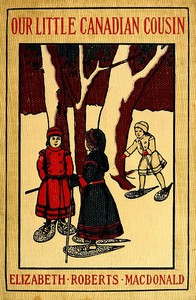
Our Little Canadian Cousin — Key Ideas to Explore
(0 User reviews)
648
Project Gutenberg
2013
Not confirmed
Family -- Juvenile fiction; Siblings -- Juvenile fiction; Outdoor life -- Juvenile fiction; Play -- Juvenile fiction; Amusements -- Juvenile fiction; Parent and child -- Juvenile fiction; Canada -- Social life and customs -- Juvenile fiction; Children -- Canada -- Juvenile fiction; National characteristics, Canadian -- Juvenile fiction
Readers of public-domain and historical texts
Project Gutenberg digital edition
en
Edition facts
Words
24,022
Reading time
105 min
Text sections
3
The source record for Our Little Canadian Cousin — Key Ideas to Explore measures this digital text at 24,022 words, 1 hr 45 min estimated reading time, and 3 detected text sections.
The text analysis averages about 20.6 words per sentence, while the detected sections provide another way to judge how the source is divided.
Project Gutenberg metadata also associates the work with “Family -- Juvenile fiction,” connecting these edition facts with the source record’s subject description.
Source:
Project Gutenberg record #43249
This editorial note examines how the opening, middle, and later excerpts of Elizabeth Roberts MacDonald's 1904 children's novel guide a first reading, focusing on the author's preface, the formation of a patriotic children's society, and the domestic setting.
Editorial Edition Score
4.6/5
★★★★★
★★★★★
Calculated from edition completeness, EPUB availability, text structure and catalogue metadata. Not a user rating.
How this score is calculated
- Description quality20 pts
- Title & short description10 pts
- Source metadata20 pts
- Text length15 pts
- Chapters / structure15 pts
- EPUB file integrity20 pts
Total of 100 points, scaled to a 2.5-5.0 range. Editions with an empty description or a missing EPUB file are not scored.
Edition quality
Public-domain source text
Read the source text
The source text is kept in the dedicated reader, separate from this catalogue record and its commentary.
The author's preface positions Our Little Canadian Cousin as an intentional portrait of Canadian home life, emphasizing outdoor activities—sleighing, skating, snow-shoeing, hunting, canoeing, and camping out—as central to the experience. MacDonald explicitly states her aim to tell a story of Canadian home life with a defined local setting, while acknowledging the impossibility of covering the country's full variety of climate, scenery, or history in a single small story. This framing prepares the reader for a focused, domestic narrative that uses outdoor recreation as a window into national character.
The Preface as a Compact Mission Statement
The preface, though brief, establishes the book's core tension: it promises a general story of Canadian home life but immediately concedes its limitations. MacDonald writes that treating the country's climate, scenery, or history adequately would require far more scope than this one small story allows. This honest narrowing of ambition signals to the reader that the book will not attempt a comprehensive survey but will instead concentrate on a single family's experiences. The preface also foregrounds the importance of outdoor life, listing specific activities—sleighing, skating, snow-shoeing, hunting, canoeing, and camping out—as the joys of a vast, uncrowded country where there is room to play. This list functions as a thematic menu, alerting the reader to the kinds of episodes likely to appear.
The Children's Society as a Structural Device
In the middle excerpt, the children form a patriotic society called the Sons and Daughters of Canada. This episode reveals how the book uses child-led organization to explore national identity. Jackie's idea originates from attending a Sons of England anniversary service, and the children's debate over names—rejecting Maple-leaves and Beavers as too common—shows their earnest desire for a distinctively Canadian label. The society includes adults as honorary patrons and a secretary-treasurer, blending generations in a shared project. Katherine proposes a regular course of study in Canadian history and literature, suggesting that the book will weave educational content into the narrative. The society's creation also provides a framework for subsequent activities, making it a structural pivot for the story's middle section.
Domestic Spaces and Indoor Occupations
The excerpt set in Mrs. Merrithew's den contrasts two domestic spaces: mother's den, described as the very cosiest room in the house, and father's study, which looks too much like an office to suit the children. This distinction underscores the book's alignment with a maternal, domestic sphere where reading and imaginative play occur. On a bleak day with scanty flakes falling, the children occupy themselves indoors: Katherine reads Rob Roy, Jack builds a castle of blocks, Dora dreams in the window-seat, and Marjorie tries to teach a cat to beg. The scene establishes a rhythm of indoor and outdoor life, with the den as a hub for planning and reflection. The cozy interior contrasts with the vast outdoor spaces mentioned in the preface, creating a balanced setting for the narrative.
Voice and Characterization Through Dialogue
The dialogue in the society-forming scene reveals character through speech patterns. Jackie's earnest proposal of a patriarchal society (corrected to patriotic) and his insistence that the name Sons and Daughters of Canada is best because everybody is either a son or a daughter, even twins, shows his literal-minded enthusiasm. Dora's drowsy sarcasm—Not quite all—adds a dry humor. Marjorie's thoughtful suggestion of Maple-leaves or Beavers is dismissed by Jackie as baseball club names. Katherine, the adult figure, gently corrects and guides without dominating. The children's language is natural and age-appropriate, with Jackie's hesitant pronunciation (patri—oh, you know what) and his careful inclusion of adults in the society. These exchanges give the characters distinct voices and make the domestic scenes feel lively and specific.
Readers approaching Our Little Canadian Cousin for the first time will find that the excerpts reward attention to small details: the contrast between mother's den and father's study, the children's precise vocabulary, and the way patriotic sentiment emerges from everyday play. The book's structure, moving from preface to society formation to indoor scenes, suggests a narrative that balances instruction with entertainment. The excerpts do not reveal the full arc, but they establish a clear pattern of domestic life punctuated by organized, child-driven projects.
That rainy afternoon, I lingered over Our Little Canadian Cousin, struck by how domestic quiet shaped patriotism. Later, drifting through the shelf, I pulled down Mary Lee the Red Cross Girl — Inside the Classic almost without thinking. Same era, same gentle earnestness—but the war changes everything. I kept noticing how courage hides in ordinary rooms, waiting.
There are no reviews for this eBook.
There are no comments for this eBook.
Reader reflection
How did this book work for you?
Your answers remain private and are stored only in this browser.
Your progress
0
/
10
2
How much did you enjoy the reading experience?
3
Would you encourage someone else to read it?
4
What was the reading difficulty like?
5
Was the book easy to understand?
6
What was the strongest part of the book?
7
How distinctive were its ideas or approach?
8
Did the book give you something worth debating?
9
Which lesson or insight stayed with you?
10