
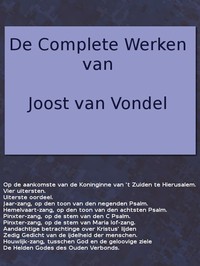
De complete werken van Joost van Vondel. Op de Aankomste van de Koninginne van…
Picking up a 17th-century poem about a royal visit might sound like homework, but stick with me. Vondel's work is a fascinating window into a time when poetry was public spectacle and political tool.
The Story
In 1638, Maria de' Medici, the exiled Queen Mother of France, visited Amsterdam. The city rolled out the red carpet, and Vondel, the rockstar poet of his day, was commissioned to write the official welcome. He didn't just write 'We're glad you're here.' He built an entire epic in miniature. The poem portrays the Queen's arrival as a divine event. She sails into the harbor as a bringer of peace and a champion of the Catholic faith (a tricky subject in Protestant Amsterdam). Allegorical figures like Envy and Sedition rise from the murky waters to oppose her, symbolizing the political and religious tensions of Europe. But Amsterdam itself, personified as a virtuous and strong maiden, welcomes and protects her. The Queen's presence blesses the city, promising continued trade success, artistic flourishing, and moral righteousness. It's a story about a city putting its best foot forward for the world to see.
Why You Should Read It
Look past the older language and you'll find something surprisingly modern. This is a masterclass in political spin and civic branding. Amsterdam was showing off, and Vondel was its chief marketer. The poem wrestles with big ideas that still matter: how do we welcome outsiders? How does a city build its identity? Can art create unity? Reading it, you feel the city's pride and anxiety. You also get Vondel's personal voice—his deep Catholic faith coloring a celebration in a largely Protestant city makes for complex, layered writing. It's not a dry history lesson; it's a passionate, artistic argument for peace, prosperity, and prestige.
Final Verdict
This one's for the curious reader. It's perfect if you love history, but want to see it through art, not just dates and battles. If you're interested in how politics and poetry collide, or if you just want to time-travel to the bustling docks of 1600s Amsterdam for an hour, give it a go. It's short, dense, and packed with meaning. You won't get a thriller plot, but you will get a brilliant snapshot of a moment when a whole city held its breath, put on a show, and asked a poet to make it immortal.
This historical work is free of copyright protections. You are welcome to share this with anyone.






Patricia Thomas
2 months agoI particularly value the technical accuracy maintained throughout.