
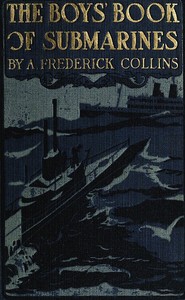
The Boys' Book of Submarines by A. Frederick Collins and Virgil D. Collins
First published in 1916, 'The Boys' Book of Submarines' is exactly what it sounds like: a guide written to capture the imagination of young readers at a time when submarines were the cutting-edge, terrifying new weapon of World War I. But don't let the title fool you—this isn't a childish book. It's a detailed and surprisingly thrilling tour of early submersible technology.
The Story
There isn't a fictional plot here. Instead, the book walks you through the entire world of early submarines. It starts with the basic principles: how do you make a heavy metal tube sink and then float again? From there, it takes you on a tour. You'll learn about the different types of subs, from small coastal defenders to larger fleet boats. You get detailed looks at the engines, the diving planes, the periscopes, and those claustrophobic living quarters. The authors explain everything from how a torpedo is fired to how the crew navigates while blind underwater. It's a complete operator's manual, written with palpable excitement for the subject.
Why You Should Read It
The charm of this book is its perspective. Reading it today is like stepping into a 1916 mindset. The tone is one of patriotic awe and scientific curiosity. The authors are clearly impressed by this new technology, yet they don't shy away from the dangers—the risk of getting stuck on the bottom, the threat of hull collapse, the pure bravery required. The illustrations and diagrams are fantastic, not as polished as modern graphics, but full of character. They make the complex mechanics understandable. You finish the book not just knowing how a ballast tank works, but feeling a real respect for the pioneers who tested these ideas, often with their lives.
Final Verdict
This is a gem for anyone interested in naval history, early technology, or just a unique slice of life from the early 20th century. It's perfect for history buffs who want a primary source that's actually fun to read, for model builders looking for authentic details, or for any reader with a sense of adventure. While written for 'boys,' its straightforward style and fascinating content have no age limit. Think of it as a museum exhibit you can hold in your hands—a direct line to a time when going underwater in a metal tube was the most daring thing a person could do.
This masterpiece is free from copyright limitations. Thank you for supporting open literature.
Richard Thompson
1 year agoThe layout of the digital version made it easy to start immediately, the insights into future trends are particularly thought-provoking. I am looking forward to the author's next publication.
Susan Miller
3 months agoI found the data interpretation to be highly professional and unbiased.
Patricia Lee
3 months agoExactly what I was looking for, thanks!
Margaret Brown
11 months agoAfter spending a few days with this digital edition, the argument presented in the middle section is particularly compelling. This is a solid reference for both beginners and experts.










Donald Gonzalez
3 months agoIt’s rare to find such a well-structured narrative nowadays, the structural organization allows for quick referencing of key points. An excellent example of how quality digital books should be formatted.